


A single specification error in polycarbonate sheet selection costs the average industrial project $12,000-$48,000 in replacement, re-fabrication, and downtime — per incident. The choice between multiwall and solid polycarbonate sheet is about matching specific mechanical, thermal, and economic parameters to an application. Getting this wrong means solid PC sheets crack under thermal expansion, or multiwall panels deflect past limits under snow load. This guide provides the engineering data procurement teams need to decide based on measurable performance criteria for industrial and commercial applications rather than supplier claims.
Structural Performance: Load-Bearing Capacity
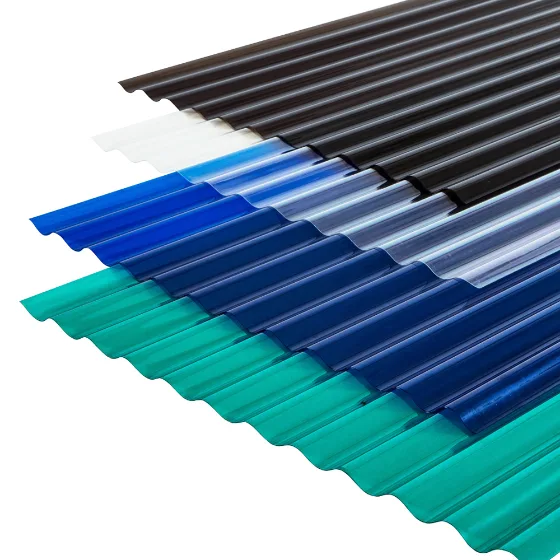
The most consequential difference is load-bearing capacity — it determines whether panels survive the first winter storm or fail catastrophically. Solid polycarbonate delivers the highest load capacity of any transparent thermoplastic. A 6mm solid sheet carries 780 N/m² at 1.2m span with deflection limited to L/50, per EN 1991-1-4:2005 wind load methodology. At 10mm, this rises to roughly 1,950 N/m² — supporting 199 kg/m². The material’s flexural modulus of 2,350 MPa (ISO 178:2019) and tensile strength of 60-70 MPa (ISO 527-2) make it the choice for machine guards (EN 16240), security glazing, and structural applications where impact resistance governs safety.
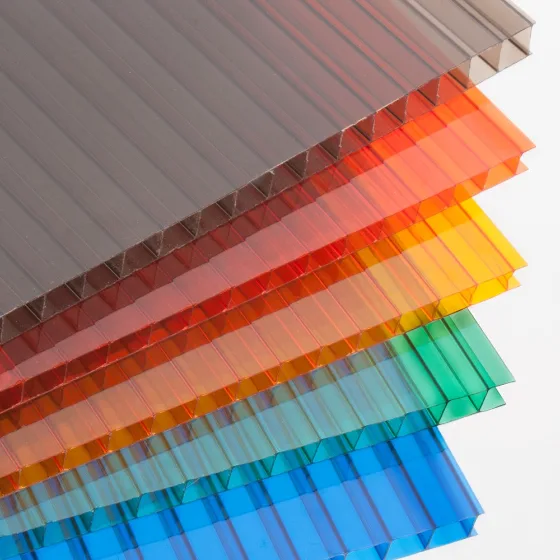
Multiwall polycarbonate achieves strength through structural geometry rather than material volume. A 16mm triple-wall panel with X-structure ribbing delivers approximately 450-520 N/m² across a 1.2m span — sufficient for roofing but below solid sheet values. The ribbed structure creates directional strength: panels outperform under longitudinal loads but lose 40-60% capacity under transverse loads. This anisotropy must be accounted for in installation orientation, a detail frequently overlooked in the field and a common cause of avoidable structural issues.
Thermal Efficiency: U-Value and Insulation Performance
Thermal performance is where multiwall dominates — the primary reason engineers select it for building envelopes. Solid polycarbonate carries a U-value of approximately 5.6 W/m²·K for 6mm (per ISO 8301) — comparable to single-pane glass with negligible insulation. In climate-controlled environments, solid PC in the building envelope guarantees excessive HVAC load and condensation risk. Multiwall polycarbonate achieves U-values as low as 1.4-1.8 W/m²·K for 16mm triple-wall, and 0.85-1.1 W/m²·K for 25mm — approaching double-glazed glass at 1/6th the weight. Trapped air cavities create thermal breaks: each additional wall layer reduces conductive heat transfer. For greenhouse operators, this means 18-35% heating cost reduction versus single-layer glazing, per CEN/TR 15601:2012. When requesting datasheets, verify U-values per ISO 8301 or EN 12667 at the installed orientation.
Three-Way Comparison: Commodity → Mid-Range → Premium
Procurement decisions fall into three tiers. Understanding where your application sits prevents both over-spending and under-specification.
| Parameter | Tier 1: Commodity | Tier 2: Mid-Range | Tier 3: Bakway IATF 16949 |
|---|---|---|---|
| Raw Material | Mixed resin | Virgin resin | Covestro Makrolon®, batch-lot traceable |
| Thickness Tol. | ±10-12% | ±5-8% | ±3% (IATF 16949 controlled) |
| UV Coating | None / single-side | Single-side | Co-extruded dual-side, 50+ μm, 10yr warranty |
| Certification | None | ISO 9001 | IATF 16949 + ISO 9001 + ISO 14001 |
| Price (per m², 8mm) | $8-12 | $14-22 | $18-28 (FOB Shanghai) |
Cost Analysis: First Cost vs Lifecycle Cost
Procurement teams evaluating solely on purchase price make the most expensive mistake in the polycarbonate supply chain. Solid polycarbonate at 8mm costs $18-28/m² versus $12-18/m² for 16mm multiwall. However, solid sheet requires simpler framing and fewer fasteners — reducing installed cost by 15-25% versus multiwall systems needing aluminum profiles and sealing tape. Multiwall’s lifecycle advantage comes from energy savings: a 10,000 m² warehouse roof switching to multiwall with U=1.6 W/m²·K can reduce annual HVAC load by 85-120 MWh — approximately $8,500-$14,000/year at industrial electricity rates. Over 15 years, energy savings exceed material cost. Contact Bakway for a project-specific quotation with FOB Shanghai freight terms.
Weight and Installation Implications
A 16mm triple-wall multiwall panel weighs approximately 2.7-3.0 kg/m². A 10mm solid sheet weighs 12 kg/m² — roughly 4× the weight. This cascading difference has real implications: solid sheets demand heavier-gauge substructures (adding $8-15/m²), ship at 3× the freight cost per unit area, and require mechanical lifting aids. In seismic zones per ASCE 7-22, lower multiwall dead load simplifies compliance. However, solid polycarbonate delivers 250× the impact resistance of glass at half the weight (ASTM D256 Izod impact), making it irreplaceable for machine guarding and security applications.
Application Selection Matrix
| Application | Best Choice | Key Driver |
|---|---|---|
| Greenhouse roofing | Multiwall | U-value 1.4-1.8, light diffusion |
| Machine safety guards | Solid | Impact resistance, EN 16240 |
| Skylights / daylighting | Multiwall | Thermal break, condensation control |
| Security glazing | Solid | Ballistic-grade impact, optical clarity |
| Carport / canopy | Either | Multiwall for insulation; solid for heavy snow |
| Optical displays | Solid | >88% transmission, zero haze |
| Sound barriers | Solid | Mass-law attenuation, EN 1793 |
| Indoor partitions | Multiwall | Lightweight, acoustic cavity |
Fabrication and Processing Differences
Solid polycarbonate can be CNC routed, laser cut, drilled, and polished with standard tooling. Edge finishing achieves optical clarity at cut edges, critical for display and signage applications. Multiwall panels require specialized handling: cuts must stay +5mm clear of ribs, aluminum sealing tape prevents moisture ingress on top edges, and breathable filter tape on bottom edges allows drainage. Improper edge sealing is the #1 cause of multiwall premature failure — condensation triggers U-value degradation of 40-60% and delamination within 2-4 years. Bakway’s fabrication division provides 23+ precision processing services including CNC routing, edge polishing, and custom cut-to-size.
Price, MOQ, and Lead Time
Solid sheets: standard 2,050mm × 3,050mm, thickness 0.8mm-20mm, MOQ 50 sheets, lead time 7-10 days stock / 15-20 days custom. Multiwall panels: width 2,100mm, length cut-to-order up to 12m, thickness 4mm-25mm, MOQ 50 sheets, lead time 10-14 days standard / 18-25 days custom. Custom options: anti-scratch hard coating, ESD anti-static, IR-block, and RAL color matching at 200+ sheet MOQ. Export packaging: palletized with PE film + plywood case + steel strap with moisture barrier. Request technical datasheets — get your project quote within 24 hours.
FAQ
Can multiwall polycarbonate handle heavy snow loads?
A 16mm triple-wall panel at minimum 10° roof pitch with purlin spacing ≤1.0m supports approximately 500 N/m² (50cm of fresh snow). For design snow loads exceeding 1.0 kN/m² per EN 1991-1-3, solid polycarbonate at 8-10mm or reduced-span multiwall with structural support is recommended. Always provide local snow load data when requesting a quotation — Bakway’s engineering team includes structural verification with every project quote.
Which offers better long-term UV resistance?
UV resistance depends on coating quality, not panel structure type. Bakway’s co-extruded UV coating is 50+ μm thickness, molecularly bonded during OMIPA co-extrusion — not spray-applied, which delaminates within 2-3 years. The 10-year warranty covers yellowing and impact strength per ISO 4892-2 (3,000 hours xenon arc). Dual-side UV coating is available for freestanding panels. Always verify coating method in supplier documentation — co-extruded outperforms spray-applied by 3-5× in real-world service life.
Can multiwall and solid sheets be used together?
Yes — solid polycarbonate for vertical glazing requiring impact resistance, paired with multiwall panels for roofing where thermal insulation drives ROI. This hybrid approach optimizes safety and energy performance while maintaining design consistency. It is increasingly common in commercial construction. Bakway provides both panel types in matching color and UV specifications from a single production batch, ensuring consistent appearance and unified warranty coverage across the entire project.
About Bakway Advanced Material Co., Ltd.
Bakway Advanced Material Co., Ltd. is the largest and most professional PC sheet manufacturer in Eastern China, with 40,000m² of base sheet production workshop and 15,000m² of sheet processing workshop. Located just 80km from Shanghai Port, we offer efficient sea freight worldwide. Our Singapore and Indonesia branches enable direct transshipment globally, saving significant import duties for customers. With IATF 16949, ISO 9001 and ISO 14001 certifications, we provide 23+ precision processing services to clients across 40+ countries. Contact us for free samples and competitive quotes.
References
- EN 1991-1-4:2005 — Eurocode 1: Actions on structures — Wind actions. CEN, Brussels.
- ISO 178:2019 — Plastics — Determination of flexural properties. ISO, Geneva.
- ISO 527-2:2012 — Plastics — Determination of tensile properties. ISO, Geneva.
- ISO 8301:1991 — Thermal insulation — Determination of steady-state thermal resistance. ISO, Geneva.
- EN 16240:2014 — Light transmitting flat solid polycarbonate sheets for roofs, walls and ceilings. CEN, Brussels.
- ISO 4892-2:2013 — Plastics — Exposure to laboratory light sources — Xenon-arc lamps. ISO, Geneva.
- ASTM D256-23 — Izod Pendulum Impact Resistance of Plastics. ASTM International.
- CEN/TR 15601:2012 — Hygrothermal performance of buildings. CEN, Brussels.
Article prepared by Bakway’s engineering content team. Technical data verified against current ISO, EN, and ASTM standards as of June 2026. Contact Bakway’s technical support for the most current material datasheets, free samples, and a competitive quotation for your project.
