

When designing a greenhouse, industrial facility, architectural feature, or safety installation, one of the most critical choices you’ll face is the glazing material. Two contenders dominate the conversation: polycarbonate sheets and traditional glass. While glass has been the default for centuries, polycarbonate has rapidly gained ground across commercial, industrial, and residential applications — and for good reason. This comprehensive comparison breaks down the key differences across strength, weight, insulation, cost, UV protection, and real-world performance to help you make the right call.
1. Impact Resistance: The Defining Difference
This is where polycarbonate wins decisively. Polycarbonate is approximately 250 times stronger than standard glass and virtually unbreakable under normal use conditions. Even laminated or tempered glass — which is far stronger than annealed glass — cannot match polycarbonate’s impact resistance. In standardized impact testing (such as ASTM D256 for Izod impact), polycarbonate consistently outperforms all glass variants by orders of magnitude.
Consider this: a 4mm solid polycarbonate sheet can withstand a hammer blow that would shatter 6mm tempered glass. In hail-prone regions, polycarbonate roofing panels routinely survive storms that destroy glass greenhouses overnight. This is why polycarbonate is the material of choice for industrial safety glazing, machine guards, riot shields, and bullet-resistant barriers.
Glass, even in its strongest tempered form, remains brittle. Once its yield point is exceeded, it shatters completely — creating dangerous shards and losing all structural integrity. For applications where safety is non-negotiable, polycarbonate is simply the superior choice.
2. Weight: The Logistics and Structural Advantage
Polycarbonate weighs roughly half as much as glass of equivalent thickness. A 4mm glass pane weighs approximately 10 kg/m², while a 4mm solid polycarbonate sheet weighs only about 4.8 kg/m². Multiwall polycarbonate panels are even lighter — a 10mm twin-wall panel weighs around 1.7 kg/m² while providing excellent structural performance.
This weight advantage cascades through the entire project lifecycle:
- Lower structural requirements — Lighter glazing means you can use smaller steel or aluminum framing members, reducing material costs by 15-30%.
- Easier handling and installation — Workers can carry and position polycarbonate sheets without specialized lifting equipment, cutting labor time and improving on-site safety.
- Reduced shipping costs — You can transport more polycarbonate per truckload than glass, and the material doesn’t require the same level of protective packaging.
- Retrofit-friendly — Polycarbonate can often be installed over existing structures without reinforcement, making it ideal for renovation projects.
3. Thermal Insulation: The Multiwall Advantage
Single-pane glass has a U-value of approximately 5.7 W/m²K — meaning it loses heat rapidly. Double-glazed glass improves to around 2.8 W/m²K, and triple-glazed reaches approximately 1.8 W/m²K, but at a significant cost and weight premium.
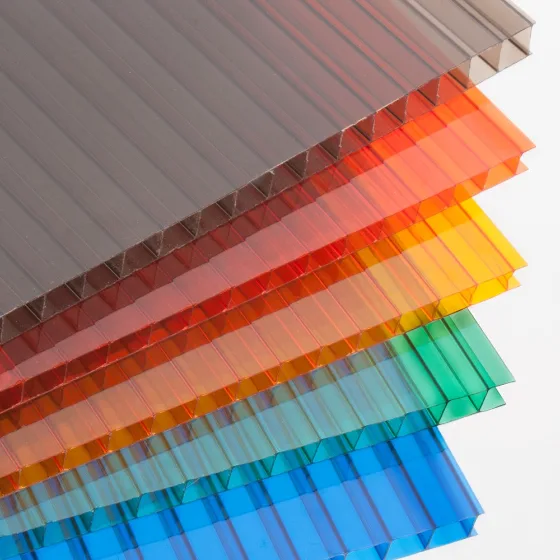
Multiwall polycarbonate panels, by contrast, achieve U-values as low as 1.4 W/m²K with a 25mm 7-wall structure — outperforming even triple-glazed glass — without the weight penalty. The secret lies in the multi-chamber design, which creates dead air spaces that dramatically slow heat transfer. This is why polycarbonate dominates greenhouse and conservatory construction worldwide: it keeps plants warm in winter and reduces heating costs by 40-60% compared to single-pane glass.
For comparison:
| Material | Thickness | U-Value (W/m²K) |
|---|---|---|
| Single Glass | 4mm | 5.7 |
| Double Glazed Glass | 24mm | 2.8 |
| Solid Polycarbonate | 4mm | 5.3 |
| Twin-Wall Polycarbonate | 10mm | 3.0 |
| Multi-Wall Polycarbonate | 25mm | 1.4 |
4. Light Transmission and UV Protection
Glass offers excellent light transmission — typically 88-90% for clear glass — and does not degrade under UV exposure. However, it transmits nearly all UV radiation, which causes fading, material degradation, and, in greenhouse applications, can harm certain plants.
Polycarbonate sheets are co-extruded with a UV-protective layer that blocks 98-99% of harmful UV radiation while maintaining 80-88% visible light transmission depending on thickness and structure. This is crucial for:
- Greenhouse applications — Plants receive beneficial PAR (photosynthetically active radiation) while being protected from UV damage.
- Architectural skylights and canopies — Interior furnishings, flooring, and artwork are shielded from UV-induced fading.
- Outdoor signage — Graphics and colors remain vibrant for years longer than under glass.
One important note: polycarbonate’s UV coating does have a finite lifespan — typically 10-15 years depending on exposure conditions. Our sheets feature a 50-micron co-extruded UV layer, which is significantly thicker than the industry standard 30 microns, providing extended outdoor durability. Glass, by contrast, never loses its UV-blocking ability (though it offers almost none to begin with without specialized coatings).

5. Cost: Initial Investment vs. Lifetime Value
At first glance, glass appears cheaper. Standard 4mm float glass costs approximately $8-12/m², while 4mm solid polycarbonate runs $15-25/m². However, this narrow comparison misses the bigger picture:
Installation costs — Glass requires heavier framing, specialized handling equipment, and higher labor costs. Polycarbonate’s lighter weight and ease of cutting with standard tools reduce installation time by 30-50%.
Breakage and replacement — A single broken glass pane in a greenhouse or skylight means emergency replacement costs, potential crop loss, and safety hazards. Polycarbonate’s virtual unbreakability eliminates this ongoing cost. Over a 10-year period, facilities using polycarbonate typically see 80-90% lower replacement costs than glass installations.
Energy savings — The superior insulation of multiwall polycarbonate translates directly to lower heating and cooling bills. For a 500m² greenhouse, switching from single-pane glass to 10mm twin-wall polycarbonate can save $2,000-5,000 annually in climate control costs.
Total cost of ownership over a 15-year period typically favors polycarbonate by 25-40% for most commercial and industrial applications when you factor in installation, energy, maintenance, and replacement costs.
6. Scratch Resistance and Longevity
This is glass’s strongest argument. Glass is extremely hard (Mohs hardness ~6-7) and resists scratching from dust, cleaning, and environmental abrasion. It can maintain optical clarity for decades with minimal maintenance. Glass also does not yellow or haze over time — a 50-year-old glass window looks essentially the same as a new one.
Polycarbonate is softer and more prone to surface scratching if not handled properly. However, modern polycarbonate sheets come with abrasion-resistant coatings that significantly improve scratch resistance. For most applications — roofing, greenhouse glazing, machine guards — this is sufficient. For high-traffic areas where the surface is regularly touched or cleaned (such as retail display cases), glass or acrylic may be a better choice.
Yellowing was historically a concern with early polycarbonate products, but today’s UV-stabilized sheets from reputable manufacturers like Bakway use advanced co-extrusion technology that prevents yellowing for 10-15+ years in outdoor conditions.
7. Cold Bending and Design Flexibility
One area where polycarbonate dramatically outperforms glass is cold bending. Polycarbonate sheets can be bent on-site to create curved roofs, arched walkways, and barrel vaults — without heating or specialized equipment. The minimum cold bending radius for polycarbonate is approximately 150 times the sheet thickness (e.g., a 4mm sheet can be bent to a 600mm radius).
Glass cannot be cold bent — any curved glass application requires expensive thermal bending in a kiln, which adds weeks to lead times and 3-5x to material costs. For curved architectural designs, polycarbonate is not just the economical choice — it’s often the only practical one. Explore our range of multiwall polycarbonate sheets for curved roof applications.
8. Where Each Material Excels
Choose Polycarbonate When:
- Impact resistance and safety are priorities (machine guards, skylights, schools)
- You need thermal insulation (greenhouses, conservatories, atriums)
- Weight is a concern (retrofit projects, large spans, lightweight structures)
- You require cold bending or curved designs
- UV filtration matters (plant growth, UV-sensitive interiors)
- You want lower total cost of ownership over 10+ years
Choose Glass When:
- Scratch resistance is paramount (high-touch surfaces, museum displays)
- Optical clarity must remain pristine for 30+ years without maintenance
- Fire rating requirements demand non-combustible materials
- Budget constraints favor lowest upfront cost for small, simple installations
- Historical restoration requires period-authentic materials
Frequently Asked Questions
Is polycarbonate really 250 times stronger than glass?
Yes. The 250x figure refers to impact resistance — the amount of energy a material can absorb before fracturing. In standardized Izod impact testing (ASTM D256), polycarbonate registers 600-850 J/m, while standard glass registers approximately 2.5-3 J/m. In practical terms, a polycarbonate sheet will stop a thrown brick; a glass pane of the same thickness will shatter. This is why polycarbonate is specified for hurricane-resistant glazing, safety barriers, and security applications worldwide.
Which is better for a greenhouse: polycarbonate or glass?
For most greenhouse applications, polycarbonate — specifically multiwall or twin-wall panels — is the superior choice. It provides 40-60% better thermal insulation than single-pane glass, diffuses light more evenly (reducing plant scorching), blocks harmful UV rays, and is virtually unbreakable against hail and wind-blown debris. Glass greenhouses look beautiful and offer unmatched clarity, but the higher heating costs, breakage risk, and heavier structural requirements make polycarbonate the practical choice for commercial growers and serious hobbyists alike. Learn more about our greenhouse polycarbonate solutions.
How long does polycarbonate last compared to glass?
Glass can last 50+ years with virtually no degradation in optical quality. Polycarbonate has a functional outdoor lifespan of 10-20 years depending on UV exposure, coating quality, and maintenance. Premium polycarbonate sheets with thick UV co-extrusion layers (50 microns or more) and proper installation can maintain structural integrity and acceptable clarity for 15-20 years. While polycarbonate won’t match glass’s century-long durability, its cost advantages in installation, energy, and breakage prevention typically make it the more economical choice over any reasonable project lifecycle.
About Bakway Advanced Material Co., Ltd. — Bakway Advanced Material Co., Ltd. is the largest and most professional PC sheet manufacturer in Eastern China, with 40,000㎡ of base sheet production workshop and 15,000㎡ of sheet processing workshop. Located just 80km from Shanghai Port, we offer efficient sea freight worldwide. Our Singapore and Indonesia branches enable direct transshipment globally, saving significant import duties for customers. With IATF 16949, ISO 9001, and ISO 14001 certifications, we provide 23+ precision processing services to clients across 40+ countries. Contact us for free samples and competitive quotes.