

Introduction: Three Tiers of Cannabis Greenhouse Covering — Which One Wins Over 10 Years?
North America’s legal cannabis market reached $36-55 billion in 2025 (Grand View Research, IMARC Group), growing at 11.9-22.6% CAGR. The commercial greenhouse market — driven heavily by cannabis cultivation — hit $7.65 billion in 2025 (Market Data Forecast). Growers migrating from indoor warehouses to greenhouses are discovering a critical truth: the choice of covering material makes or breaks the economics of a 10-year cultivation license.
But here’s what almost no one tells you: there are three fundamentally different tiers of greenhouse covering, and the gap between them widens every year. This article compares all three head-to-head — so you can see exactly where your cultivation facility stands, and what you’re leaving on the table.
The Three Tiers: A Side-by-Side Comparison
Every cannabis greenhouse falls into one of these three categories. Which one are you building — or stuck with?
| Factor | Tier 1 Traditional Greenhouse | Tier 2 Light-Conversion PE Film | Tier 3 Light-Conversion PC Panels ★ |
|---|---|---|---|
| Covering Material | Standard PE film or glass | PE film + rare-earth additives | PC panel + Nano Rare-Earth coating |
| Light Conversion? | ❌ None | ⚠️ Yes — temporary | ✅ Yes — permanent |
| Service Life | 3-5 years (glass: 20+) | 2-3 years | 10+ years (warranted) |
| Year-5 Light Transmission | 55-65% (film), 85%+ (glass) | 60-65% | 80-89% (stable) |
| Conversion Stability | N/A | Degrades yearly (additive leaching) | Stable for 10+ years |
| Thermal Insulation (K-Value) | ~6.5 (film), ~5.7 (single glass) | ~6.5 W/m²·K | 1.5-3.0 W/m²·K (multiwall) |
| Condensation Control | Drips onto canopy | Drips onto canopy | Anti-Drop technology |
| Impact Resistance | Tears (film), shatters (glass) | Tears, punctures | 250× stronger than glass |
| Global Suppliers | Hundreds | Dozens | ONE — Bakway ★ |
★ Bakway is the world’s only manufacturer of polycarbonate greenhouse panels with integrated Nano Rare-Earth light-conversion coating.
Tier 1: Traditional Greenhouse — The Baseline That’s Costing You Yield
Most cannabis greenhouses in North America are covered with standard polyethylene film. It’s the default choice because it’s cheap — $0.08-0.15/sq ft — and everyone else uses it.
But “standard” means zero spectral optimization. Sunlight hits the plants as-is: roughly 5% UV, 45% visible (only half of which is photosynthetically active), and 50% infrared. The UV portion isn’t just wasted — at high doses, it stresses cannabis plants and suppresses terpene production. The infrared heats the greenhouse in summer but provides no photosynthetic value.
For a 10,000 sq ft facility producing 500 kg/year, roughly 200 kg of potential yield is simply never created — because the light spectrum is suboptimal. At wholesale prices of $800-1,200/kg, that’s $160,000-240,000 in annual unrealized revenue. Year after year.
And then there’s the replacement cycle. PE film lasts 3-4 years. A 10-year cultivation license means 2-3 complete re-skins, each costing $15,000-20,000 in materials, labor, and production downtime. And unlike a factory that can pause a production line, a cannabis greenhouse cannot “pause” a flowering cycle.
Tier 2: Light-Conversion PE Film — A Temporary Upgrade With a Hidden Clock
Recognizing the yield gap, several film manufacturers now embed rare-earth phosphors into PE film to convert UV into photosynthetically active red/blue light. This is a genuine improvement over Tier 1 — in Year 1.
The problem is structural: the light-conversion additives are physically dispersed in the polymer matrix, not chemically bonded. Every day of UV exposure, every condensation cycle, every temperature swing leaches a fraction of those additives out of the film. The grower doesn’t see it happening. But the harvest scale does.
A Tier 2 facility producing 500 kg/year in Year 1 will produce:
- Year 1: 500 kg (full conversion efficiency)
- Year 2: 450 kg (10% decline)
- Year 3: 400 kg (20% decline — film is now essentially Tier 1)
Then the grower faces the same replacement decision as Tier 1 — but with the added frustration of knowing exactly what performance they lost. Over 10 years with three replacements, cumulative yield loss exceeds $280,000 from additive degradation alone, before even accounting for replacement costs.
Tier 3: Light-Conversion PC Panels — The Permanent Infrastructure Play
This tier didn’t exist until Bakway developed it. As of 2026, Bakway is the only manufacturer in the world producing polycarbonate greenhouse panels with integrated Nano Rare-Earth light-conversion coating.
The technology solves every failure mode of Tier 2 at the structural level:
1. Conversion Stability: Chemically Bonded, Not Dispersed
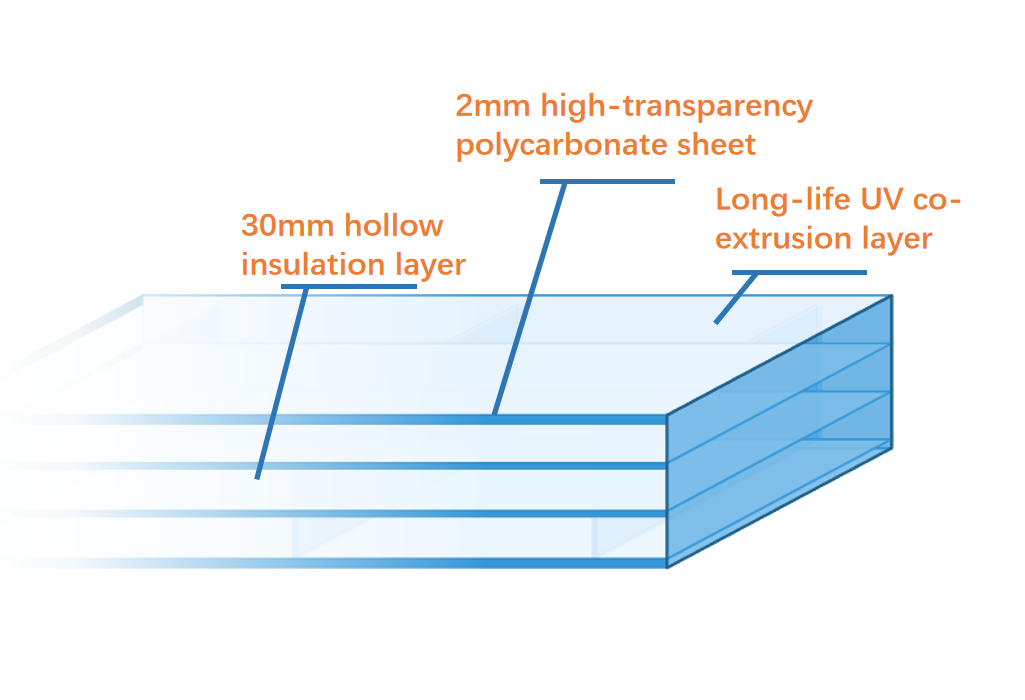
Bakway’s Nano Rare-Earth coating is chemically bonded to the polycarbonate surface during co-extrusion — not mixed into the polymer. This means the conversion layer is functionally independent of the panel’s aging process. The 50μm UV-protective cap layer prevents yellowing for 10+ years; the conversion coating maintains its spectral output for the same period. A panel in Year 7 converts UV at the same efficiency as Year 1.
2. Heating Cost Reduction: The Hidden Profit Driver
Multiwall polycarbonate panels achieve K-values as low as 1.5 W/m²·K — 4× better insulation than single-layer PE film. Cannabis greenhouses in Canada and the northern US face winter heating bills of $15,000-25,000/month. A 50-70% reduction means $7,500-17,500 saved every winter month. Over a 10-year cultivation license, heating savings alone can exceed the entire premium of the PC panels.
3. Anti-Drop: Preventing the #1 Crop Killer
Condensation dripping onto cannabis flowers is a direct vector for botrytis (bud rot). Both Tier 1 and Tier 2 films form large droplets that fall when they reach critical mass. Bakway panels feature Anti-Drop technology that creates a continuous water film sheeting to the gutters. In high-humidity cultivation environments, this single feature prevents 5-15% crop loss — potentially $40,000-180,000 over 10 years for a mid-size facility.
4. The 10-Year TCO: Three Tiers, Three Realities
For a 10,000 sq ft cannabis greenhouse in Ontario producing 500 kg/year at $900/kg wholesale:
| Cost Category (10 Years) | Tier 1: Traditional | Tier 2: PE Film + LC | Tier 3: PC + LC ★ |
|---|---|---|---|
| Initial Covering | $1,500 | $2,500 | $28,000 |
| Replacements (×2-3 over 10yr) | $30,000 | $45,000 | $0 |
| Yield Loss (suboptimal spectrum + degradation) | $450,000+ | $280,000+ | $0 |
| Heating Premium (vs Tier 3) | $90,000+ | $90,000+ | Baseline |
| 10-Year Total Cost | ~$571,500 | ~$417,500 | ~$28,000 |
*Tier 1 yield loss based on zero spectral optimization (baseline 20% below Tier 2 peak) × 10 years. Tier 2 yield loss from additive degradation curve (Years 2-3 decline per cycle × 3 replacements). Heating calculated at $1,500/month premium vs Tier 3 insulation for 6 cold months/year × 10 years.
How Light Conversion Works for Cannabis Specifically
Not all light is equal for cannabis. The plant’s photosynthetic action spectrum shows two peaks:
- Red light (620-700nm): Drives biomass accumulation — bigger buds, higher THC production. This is the “yield engine.”
- Blue light (400-480nm): Regulates terpene and cannabinoid biosynthesis — aroma, flavor, potency. This is the “quality dial.”
Ultraviolet light (below 400nm) sits outside chlorophyll’s absorption range entirely. It’s wasted energy that can actually stress cannabis plants and reduce terpene production at high doses.
Bakway’s Nano Rare-Earth light-conversion coating solves this by acting as a passive spectral converter. UV photons strike the coating, excite rare-earth ions (europium for red, cerium for blue), and are re-emitted at wavelengths the plant can actually use. This is the same principle as LED grow lights — but with zero electricity cost, 24/7 operation, and no heat generation.
Two configurations are available for cannabis cultivators:
- Agri-Red: UV → 600-700nm red. Maximizes flower weight and speeds up the flowering cycle by 5-7 days. Recommended for biomass-focused operations producing extracts and distillates.
- Agri-Blue: UV → 400-480nm blue. Enhances terpene profiles, THC percentage, and bag appeal. Recommended for craft and premium flower producers.
Why Bakway Is the Only Option for Tier 3
Light-conversion PC panels are not a commodity. Manufacturing them requires three capabilities that don’t normally exist under one roof:
- PC co-extrusion at automotive-grade precision — Bakway’s 6 OMIPA lines and IATF 16949 certification mean panel thickness, UV cap layer distribution, and optical clarity are controlled to micron-level tolerances. This is the same quality system that supplies Toyota and Volkswagen.
- Nano Rare-Earth chemistry expertise — The conversion coating is a proprietary formulation. Europium and cerium ions must be precisely dosed, uniformly dispersed at nanoscale, and chemically bonded to the PC surface without compromising the panel’s impact resistance or UV stability.
- 10-year performance validation — Accelerated weathering tests (ISO 4892, ASTM G154) combined with real-world greenhouse installations across multiple climate zones confirm that both the panel structure and the conversion coating maintain spec for the full warranty period.
No other manufacturer currently offers this combination. PE film converters have the chemistry but not the structural substrate. PC extruders have the panel but not the nano-coating capability. Bakway is the sole vertically integrated supplier of light-conversion polycarbonate greenhouse panels globally.
FAQ
Is the light-conversion coating durable? Will it wash off?
No. The Nano Rare-Earth coating is chemically bonded to the polycarbonate surface during manufacturing — not painted or sprayed on. It is tested to maintain conversion efficiency for the full 10-year warranty period. Standard greenhouse cleaning procedures (water + mild detergent) do not affect it.
How does this compare to supplementary LED lighting?
Supplementary LEDs add $15,000-40,000 in equipment cost plus ongoing electricity ($3,000-8,000/year for a mid-size facility). Light-conversion panels are passive — zero electricity, zero maintenance, zero replacement. The most cost-effective approach is using conversion panels as the baseline spectral optimizer, reserving LEDs for photoperiod control only.
What if I already have a Tier 1 or Tier 2 greenhouse?
Retrofitting is straightforward. PC panels are compatible with standard greenhouse framing systems. We provide custom sizing — panels are extruded to your exact length specifications. Retrofitting typically takes 3-5 days for a mid-size facility with professional installation. The upgrade from Tier 1 to Tier 3 delivers the full yield and heating benefits. Upgrading from Tier 2 eliminates the replacement cycle permanently.
Is this suitable for all cannabis strains?
Yes. The spectral conversion is broadband within the red or blue range — it benefits all photoperiodic cannabis strains. Autoflowering varieties, which are light-cycle independent, benefit equally from the increased photosynthetic photon flux. We recommend Agri-Red for high-CBD industrial strains and Agri-Blue for high-THC craft cultivars.
What’s the minimum order?
B2B wholesale only. MOQ is one pallet — typically 100-200 panels depending on dimensions. We ship FOB Shanghai to ports across North America (Vancouver, Los Angeles, New York/Newark). Lead time is 15-25 days depending on order volume and customization requirements.
Can I get samples for testing?
Yes. We provide A4-sized sample panels (both Agri-Red and Agri-Blue configurations) for spectral testing and physical inspection. Contact us with your shipping address and we’ll arrange DHL delivery.
Conclusion: Which Tier Is Your License Built On?
The cannabis industry’s transition from warehouse to greenhouse is accelerating. But too many operators are importing the “consumable” mindset from indoor cultivation: replace bulbs every 12 months, replace film every 3 years.
Tier 1 is the default — it’s where everyone starts, and where margins go to die over a 10-year license. Tier 2 is a half-step — real gains in Year 1 that quietly evaporate by Year 3. Tier 3 treats the greenhouse covering as what it should be: permanent infrastructure with built-in yield enhancement that doesn’t degrade.
Browse our industry applications to see how PC panels serve agriculture and beyond. When your cultivation license spans a decade, the covering that needs replacing every 3 years isn’t infrastructure — it’s a subscription you never agreed to.
Request Wholesale Quote & Technical Specs →
Bakway Advanced Material (Suzhou Baitwei New Material Co., Ltd.) is the world’s only manufacturer of polycarbonate greenhouse panels with integrated Nano Rare-Earth light-conversion coating. IATF 16949-certified, operating 6 OMIPA co-extrusion lines across a 40,000 m² facility in Suzhou, China. All panels extruded from 100% virgin SABIC polycarbonate resin with a 10-year limited warranty against yellowing and light transmission loss. Serving greenhouse contractors, cannabis cultivation operators, and agricultural supply chains across North America and Europe.
References
- Grand View Research, “North America Legal Cannabis Market Report, 2030” — Market valued at $36.70B in 2023, 11.9% CAGR.
- IMARC Group, “North America Legal Cannabis Market Size & Forecast 2034” — Market valued at $55.8B in 2025, 22.62% CAGR.
- Market Data Forecast, “North America Commercial Greenhouse Market Growth, 2034” — $7.65B in 2025, 7.8% CAGR.
- IATF 16949:2016 — Automotive-grade quality management system certification held by Bakway for PC panel extrusion.
- ISO 8301:1991, EN 16240:2014 — Thermal insulation and light transmission testing standards referenced for panel specifications.
- Bakway Internal Lab Data (2024-2025): Strawberry vitamin C +40%, beta-carotene >20% increase under Agri-Red coated panels vs. standard greenhouse film.