
Introduction: The Material That Replaced Glass in Everything From Greenhouses to Fighter Jets
Walk through a modern commercial greenhouse, a police station, or a bullet-train window installation, and you’re looking at the same material: polycarbonate. It’s the transparent plastic that doesn’t behave like plastic — 250 times stronger than glass, half the weight, and capable of surviving a hailstorm that would shatter a tempered-glass skylight into a thousand pieces.
Yet for many buyers — contractors, architects, procurement managers — polycarbonate remains a material they specify without fully understanding. Is it “just plastic”? Is it as clear as glass? Does it yellow in the sun? Can it burn? This guide answers every one of those questions, from the chemistry to the cost, so you can specify polycarbonate with the same confidence you’d spec aluminum or tempered glass.
What Is Polycarbonate? A One-Minute Chemistry Lesson
Polycarbonate (PC) is a group of thermoplastic polymers containing carbonate groups (-O-(C=O)-O-) in their chemical structure. The most common commercial form is produced from bisphenol A (BPA) and phosgene, creating long chains with the repeating unit you’d recognize from any engineering textbook.
But the chemistry matters less than what it produces. The carbonate groups give polycarbonate three properties that no other transparent material combines:
- Impact resistance at the molecular level — The carbonate linkage absorbs energy through molecular motion rather than fracturing. This is why polycarbonate doesn’t shatter: when struck, the polymer chains slide past each other and dissipate the energy as heat at the impact point.
- Amorphous structure = optical clarity — Unlike semi-crystalline plastics (nylon, polyethylene) that scatter light at crystal boundaries, polycarbonate’s random molecular arrangement transmits light with 88-92% clarity, comparable to glass.
- Heat resistance without crosslinking — The rigid bisphenol-A backbone gives polycarbonate a glass transition temperature (Tg) of ~147°C, meaning it maintains structural integrity at temperatures that would deform acrylic (Tg ~105°C) and melt PVC (Tg ~80°C).
First commercialized in 1958 by Bayer (Makrolon®) and General Electric (Lexan™), polycarbonate now accounts for roughly 5 million metric tons of annual global production. SABIC and Covestro remain the dominant resin suppliers, and Bakway is among the manufacturers that extrude their virgin resin into finished sheets.
Polycarbonate vs Glass vs Acrylic: The Comparison That Matters
| Property | Polycarbonate | Tempered Glass | Acrylic (PMMA) |
|---|---|---|---|
| Impact Strength (Izod, J/m) | 600-850 | ~2 (shatters) | 16-24 |
| Light Transmission | 88-92% | 89-91% | 92% |
| Density (g/cm³) | 1.2 | 2.5 | 1.19 |
| Service Temperature | -40°C to +120°C | -40°C to +250°C | -40°C to +80°C |
| UV Stability | Co-extruded UV layer (10-year warranty) | Inherently stable | Inherently stable, may yellow |
| Fire Behavior | Self-extinguishing, chars, no flaming drips | Non-combustible (but shatters) | Burns readily, flaming drips |
| Scratch Resistance | Moderate (hard-coat available) | Excellent | Moderate |
The acrylic trap: Many buyers assume acrylic is “the same thing but cheaper.” It isn’t. Acrylic shatters under impact that polycarbonate absorbs without damage. Acrylic burns with flaming drips — polycarbonate self-extinguishes and chars. And acrylic’s lower heat resistance means it can’t be used within 1 meter of high-output LED grow lights or in applications near heat sources. For safety-critical applications — skylights, machine guards, security glazing — the cost difference between acrylic and polycarbonate is the cost of a failure.
What Are the Different Types of Polycarbonate Sheets?
Polycarbonate sheets are produced in four main configurations, each optimized for a specific set of requirements:
1. Solid Polycarbonate Sheets
Flat, monolithic panels in thicknesses from 0.5 mm to 15 mm. These are the “glass replacement” grade: optically clear, available in transparent, opal, bronze, and custom colors. Solid PC sheets are used for security glazing, machine guards, riot shields, skylights, and anywhere you need glass-like clarity with ballistic-grade impact resistance. A 12 mm solid sheet stops 9mm handgun rounds at close range.
2. Multiwall (Twin-Wall / Hollow) Polycarbonate Sheets
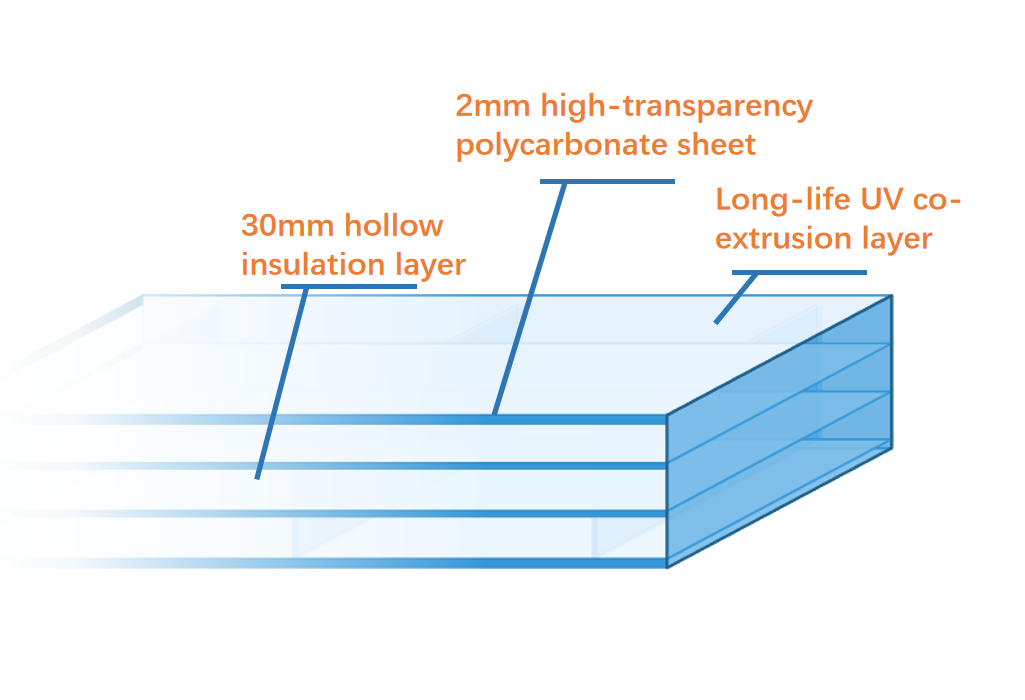
Structured panels with internal ribs creating air channels. Available in two-wall, three-wall, four-wall, X-structure, and honeycomb configurations from 4 mm to 25 mm thick. The air channels provide thermal insulation — K-values as low as 1.5 W/m²·K — while reducing weight by 40-60% compared to solid sheets of equivalent thickness. Multiwall PC sheets dominate greenhouse construction, covered walkways, and industrial daylighting applications where insulation matters more than glass-like optics.
3. Corrugated Polycarbonate Sheets
Wave or trapezoidal profile sheets, typically 0.8-1.5 mm thick. Designed for fast overlap installation on sloped roofs. The corrugation provides structural stiffness without additional framing. Corrugated PC sheets are the cost-effective choice for carports, lean-to roofs, agricultural shelters, and patio covers where quick installation and weather protection are the priorities.
4. Specialty Grades
Beyond the three main types, polycarbonate is available in specialized formulations: flame-retardant (FR-PC) for electrical enclosures and data centers (UL 94 V-0/5VA), anti-static (ESD-PC) for electronics manufacturing, abrasion-resistant (hard-coated) for high-traffic glazing, and optical-grade for LED diffusers and display applications. Bakway produces all five specialty grades in addition to standard solid/multiwall/corrugated products.
Why Doesn’t Polycarbonate Yellow in the Sun?
Unprotected polycarbonate exposed to UV radiation undergoes photo-oxidation: the polymer chains break, producing a yellow discoloration known as the Fries rearrangement. This is the #1 objection buyers have to polycarbonate, and it’s a legitimate one — for unprotected polycarbonate.
Modern polycarbonate sheets solve this at the manufacturing stage with co-extruded UV protection. During extrusion, a thin layer (typically 50 microns) of UV-absorbing material is molecularly bonded to one or both surfaces of the sheet. This cap layer absorbs UV radiation before it reaches the polycarbonate substrate, preventing the Fries rearrangement entirely. The result: a sheet that maintains optical clarity and impact strength for 10+ years of outdoor exposure.
This is the critical difference between industrial-grade polycarbonate from a manufacturer like Bakway and commodity polycarbonate from a general-purpose extruder. The UV cap layer requires precise co-extrusion equipment (Bakway uses OMIPA lines) and rigorous quality control — thickness variation of more than 5 microns in the cap layer dramatically shortens outdoor service life.
Is Polycarbonate Safe? Fire, Food Contact, and BPA
Fire safety: Polycarbonate is inherently self-extinguishing. When exposed to flame, it chars and forms a carbonaceous layer that limits further combustion. It does not produce flaming drips — a critical safety advantage over acrylic. Flame-retardant grades achieve UL 94 V-0 and 5VA ratings. For building applications, standard polycarbonate achieves EN 13501-1 Class B-s1,d0 (very limited contribution to fire, low smoke, no flaming droplets).
Food contact: Polycarbonate is FDA-approved for food contact applications and is used extensively in water bottles, food storage containers, and commercial kitchen equipment. The key consideration is BPA migration, which is regulated and well below safety thresholds for approved food-grade polycarbonate.
BPA concerns: Bisphenol A is a monomer used in polycarbonate production. Trace amounts may remain in the finished polymer. Regulatory agencies worldwide — including the European Food Safety Authority (EFSA) and US FDA — have evaluated BPA extensively and concluded that dietary exposure is far below levels of concern. For applications where BPA-free is required (infant products, medical devices), alternative polycarbonate grades and co-polyesters are available.
How Much Does Polycarbonate Cost?
Polycarbonate sheet pricing varies with thickness, grade, UV configuration, quantity, and customization. As a general reference (B2B wholesale, FOB China, 2026):
- Solid, clear, 2 mm: $6-12/m²
- Solid, clear, 6 mm: $18-30/m²
- Multiwall twin-wall, 6 mm: $4-8/m²
- Multiwall twin-wall, 10 mm: $6-12/m²
- Corrugated, 1.0 mm: $3-6/m²
- FR-PC (V-0), solid, 3 mm: $15-25/m²
Prices are indicative for B2B pallet quantities. Custom colors, cut-to-size, specialty coatings, and small-volume orders command premiums. Contact Bakway with your thickness, dimensions, and quantity for a formal quote.
FAQ
Can polycarbonate be cut with regular tools?
Yes. Polycarbonate can be cut with a circular saw (fine-tooth, 60+ teeth for 10″ blade), jigsaw, table saw, or CNC router. For thin sheets (< 3 mm), a utility knife with multiple scoring passes works. Always leave the protective film on during cutting to prevent scratches, and remove chips from multiwall channels before sealing edges.
Can polycarbonate be bent or thermoformed?
Yes. Cold bending is possible for solid sheets: minimum cold bending radius is 150× sheet thickness (e.g., 300 mm for 2 mm sheet, 900 mm for 6 mm sheet). For tighter radii and complex shapes, thermoforming at 180-210°C is used. Multiwall panels can be cold-bent along the flute direction but not across it.
How long does polycarbonate last outdoors?
UV-protected polycarbonate sheets carry a 10-year limited warranty against yellowing and significant light transmission loss. Actual service life often exceeds 15-20 years depending on climate, installation angle, and maintenance. The limiting factor is typically the UV cap layer, not the polycarbonate itself — once the cap layer is compromised, the underlying material begins to degrade.
Is polycarbonate recyclable?
Yes. Polycarbonate is Resin Identification Code #7 (“Other”). It can be mechanically recycled through grinding, washing, and re-pelletizing. However, UV-stabilized and coated grades require separation from uncoated material. Post-industrial scrap (cutting waste, edge trim) is routinely recycled back into production. Post-consumer recycling infrastructure for polycarbonate is less developed than for PET or HDPE but exists for specialized applications (CD/DVD recycling, water bottle return programs).
Conclusion: The Material That Engineers Trust When Glass Isn’t Enough
Polycarbonate is not “just plastic.” It’s an engineering thermoplastic whose molecular structure — amorphous chains linked by carbonate groups — delivers a combination of transparency, impact resistance, and thermal stability that no other transparent material matches. Glass is clearer but shatters. Acrylic is cheaper but burns and cracks. Polycarbonate is the material engineers choose when failure is not an option: aircraft canopies, riot shields, bulletproof glazing, greenhouse roofing in hail zones, and machine guards protecting operators from high-speed debris.
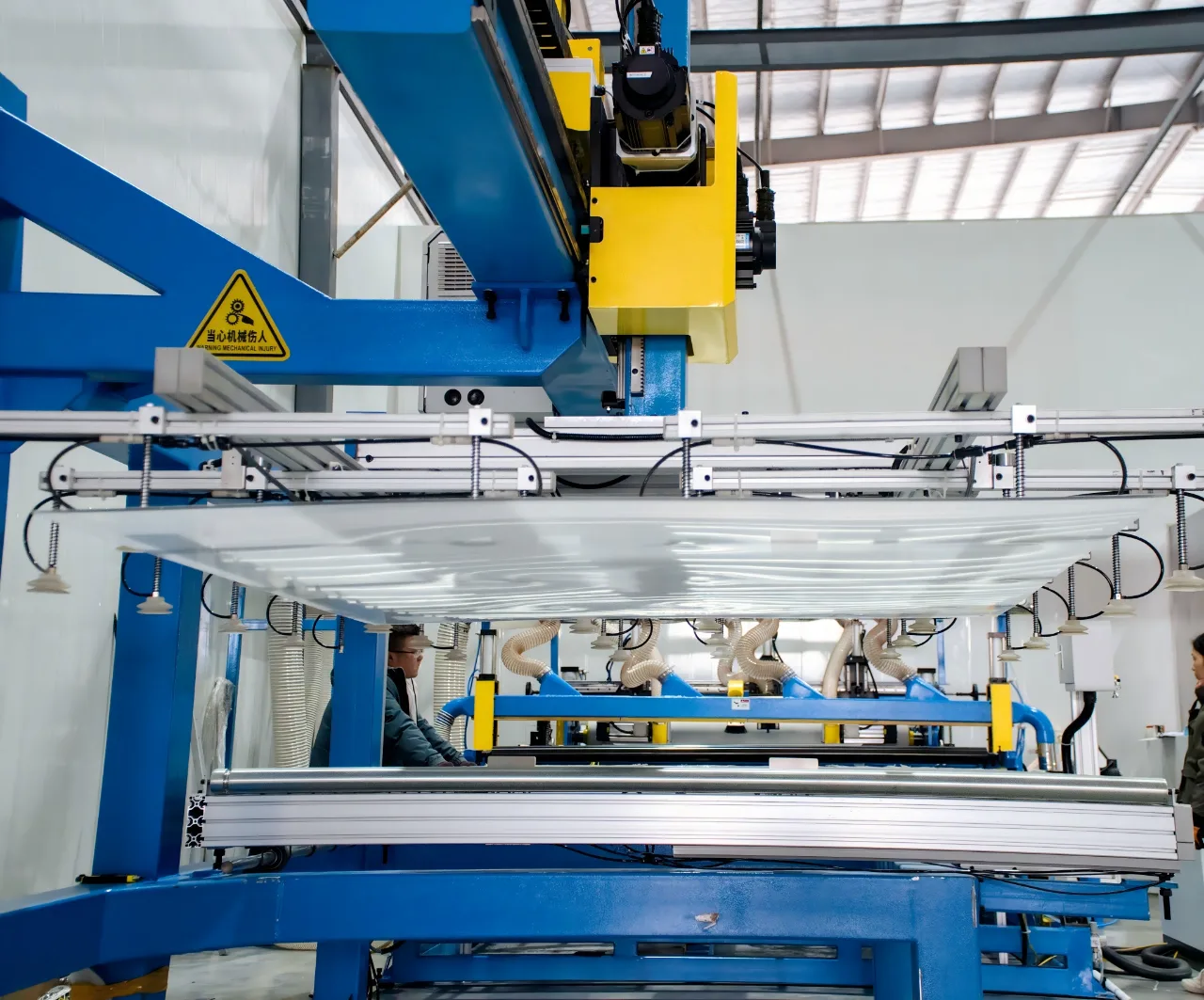
The quality of a polycarbonate sheet depends entirely on the resin, the co-extrusion process, and the manufacturer’s quality system. Virgin SABIC/Covestro resin produces sheets with consistent optical and mechanical properties. OMIPA co-extrusion lines produce UV cap layers with micron-level thickness control. IATF 16949 certification — the same quality standard that governs automotive component supply chains — ensures that every sheet meets specification.
Browse our full product catalog to explore solid, multiwall, corrugated, and specialty polycarbonate sheets for your next project.
Browse Polycarbonate Sheet Products →
Bakway Advanced Material (Suzhou Baitwei New Material Co., Ltd.) is an IATF 16949-certified manufacturer of polycarbonate sheets, operating 6 OMIPA co-extrusion lines across a 40,000 m² facility in Suzhou, China. We extrude solid, multiwall, and corrugated polycarbonate sheets from 100% virgin SABIC Lexan™ and Covestro Makrolon® resin. Products ship globally with a 10-year limited warranty against yellowing and light transmission loss.
References
- Brydson, J.A. “Plastics Materials” (7th Edition). Butterworth-Heinemann, 1999 — Chapter 20: Polycarbonates. Comprehensive reference for PC chemistry, properties, and processing.
- ISO 1183-1:2019 — Plastics — Methods for determining the density of non-cellular plastics. Reference for polycarbonate density measurement (1.2 g/cm³).
- ASTM D256-23 — Standard Test Methods for Determining the Izod Pendulum Impact Resistance of Plastics. Reference for PC impact strength values (600-850 J/m).
- EN 13501-1:2018 — Fire classification of construction products and building elements. Reference for PC fire performance (B-s1,d0).
- European Food Safety Authority (EFSA). “Scientific Opinion on the risks to public health related to the presence of bisphenol A (BPA) in foodstuffs.” EFSA Journal, 2023.
- SABIC. “LEXAN™ Sheet Technical Manual.” Fire performance, optical properties, and mechanical specifications for polycarbonate sheets.