


Light-Conversion vs Diffused Polycarbonate Panels

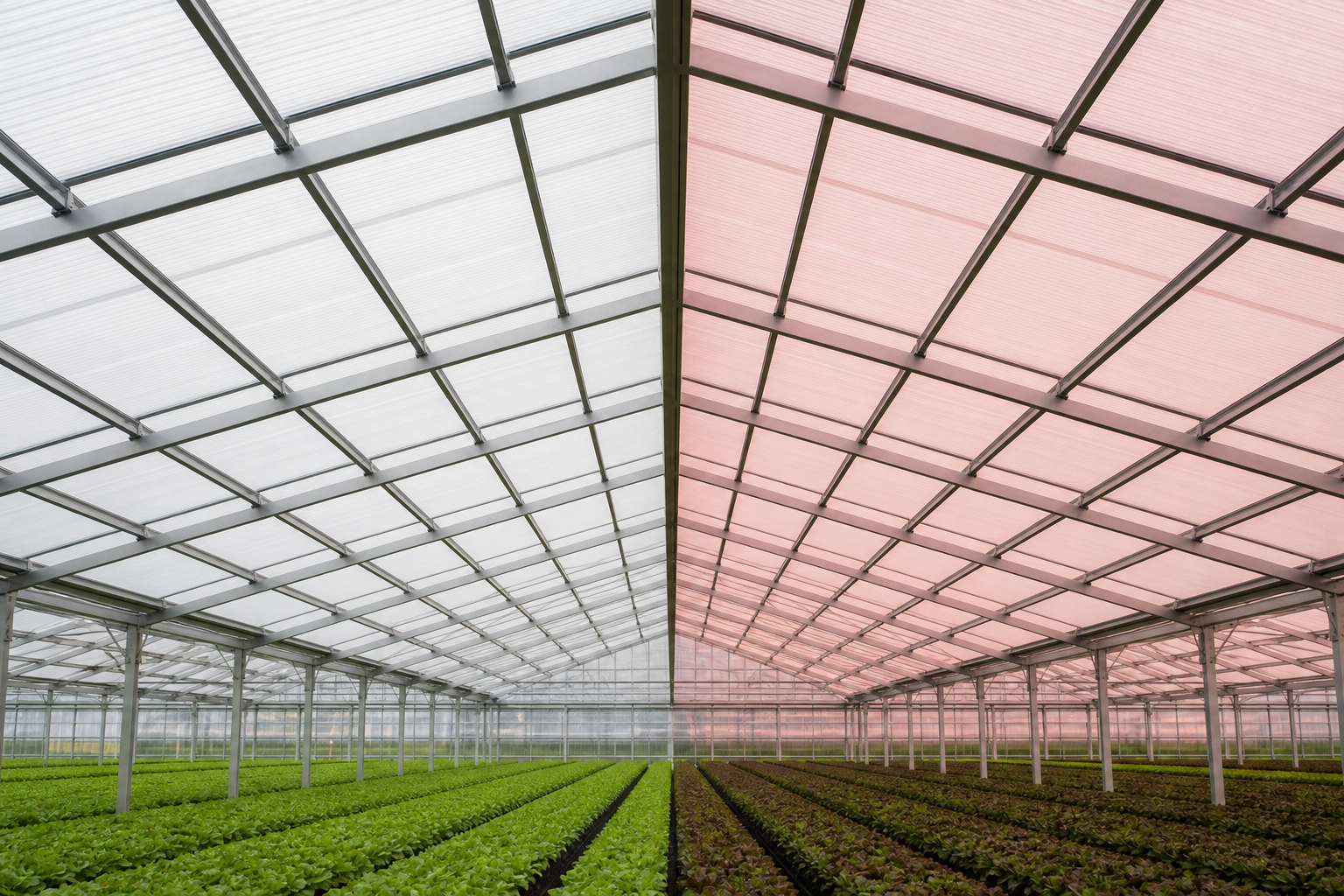
Light-conversion and standard diffused polycarbonate panels are not interchangeable greenhouse products. A diffused panel is designed mainly to scatter transmitted light over wider angles. A light-conversion panel is formulated to alter part of the wavelength distribution. Either panel may also have the other property, so buyers should compare measured optical data rather than product names.
This guide provides a procurement comparison for commercial growers, greenhouse designers and distributors. It focuses on spectrum, transmission, haze, durability, trial design and total project cost. It does not assume that one glazing type increases crop yield in every greenhouse.
Quick comparison
| Decision factor | Standard diffused panel | Light-conversion panel |
|---|---|---|
| Primary optical function | Redistributes transmitted light direction | Changes part of the transmitted wavelength distribution |
| Core measurement | Total transmission, haze and angular distribution | Spectral transmission, emission response, total transmission and haze |
| Visual appearance | Often clear, opal or lightly tinted | May have a visible tint, but color alone is not proof of conversion |
| Trial question | Does light distribution improve canopy uniformity? | Does the measured spectral change produce a useful project response? |
| Reference panel | Matched clear or standard panel | Matched diffused panel with the same construction |
| Procurement risk | Haze reported without total transmission or angular context | Marketing curve reported without energy, method or matched reference |
What diffusion changes
Diffusion reduces the concentration of transmitted light in a narrow direction and spreads it across a wider angle. In a greenhouse, this can soften sharp shadows and change how light reaches leaves below the top canopy. The effect depends on roof geometry, panel orientation, crop density and sun angle; haze is useful, but it does not fully describe angular distribution.
ASTM D1003-21 covers haze and luminous transmittance for transparent plastics. When comparing highly diffusing glazing, ask how the laboratory method relates to the supplier’s stated diffusion metric. Two products with similar haze can still differ in transmission and scattering direction.
A procurement comparison should therefore include total transmission and haze for the exact thickness and wall structure. If the supplier reports only a percentage called “diffusion,” request the method, instrument geometry and numerical definition.
What light conversion changes
Light-conversion additives absorb selected shorter wavelengths and emit part of that energy at longer visible wavelengths. The buyer needs a wavelength-dependent curve and test conditions to determine what changed. A red or pink appearance may come from absorption, pigment or fluorescence; visual color is not a quantitative spectral measurement.
The light-conversion polycarbonate buyer’s guide explains how to read the measurement file. The central purchasing point is that an emission peak does not state total converted energy, and a laboratory spectral difference does not by itself prove a repeatable crop outcome.
Can one panel provide both functions?
Yes. A greenhouse sheet can contain a light-conversion formulation and also use a surface, color or internal structure that produces diffusion. This combined approach can be useful, but it creates a more demanding comparison. Buyers must separate the spectral property from the directional property and confirm how each changes after outdoor exposure.
Ask for two document sets: spectral transmission or emission data for conversion, and transmission plus haze or angular data for diffusion. Both sets must identify the quoted panel thickness, wall geometry, GSM and color. If the documents refer to a laboratory film or a different sheet construction, they do not fully define the supplied product.
Matched-panel comparison rules
- Match thickness and wall structure. A twin-wall and a multiwall panel should not be treated as an optical-only comparison.
- Match mass per area. GSM or kg/m² affects the amount of polymer and the construction being evaluated.
- Match UV protection. Compare the same UV-side configuration and identify installation direction.
- Measure initial condition together. Test the conversion and reference panels with the same instruments and settings.
- Measure aged condition together. Compare retention after the same accelerated or outdoor exposure.
A standard multiwall polycarbonate panel can serve as the reference only when its physical construction is appropriately matched. Changing both the optical formulation and the wall structure at the same time makes it harder to identify the cause of any result.
Weathering and retention
Outdoor exposure can change transmission, haze, color and the response of additives. ISO 4892-2:2013 specifies xenon-arc exposure methods for plastics under controlled light and moisture conditions. A report should state exposure duration, irradiance, filters, temperature, moisture cycle and specimen orientation, followed by before-and-after optical measurements.
Accelerated weathering does not equal a fixed number of field years unless the supplier provides a validated correlation for the product and climate. Use it to compare retention under stated laboratory conditions. For a long-term greenhouse project, also ask how the UV layer, additive system, condensation and cleaning method affect the warranty conditions.
Crop trials: isolate the property being tested
A greenhouse trial should begin with a written hypothesis. For a diffused panel, the question may concern canopy light distribution, shade patterns or uniformity. For a light-conversion panel, the question may concern a measured spectral change and a crop response under a defined season. If the test panel also has different transmission, thickness or insulation, those differences must be recorded as additional variables.
Monitor environmental conditions in each zone. Temperature, humidity, irrigation, carbon dioxide, nutrition, disease pressure and ventilation can influence crop results. Define the harvest metric before the trial and record quality as well as mass when relevant. A result from one crop, cultivar and location should not be presented as a universal performance percentage.
For context, Bakway’s field-results archive records light-conversion film observations from several crop projects. It is deliberately labeled as film evidence: use it to understand possible trial metrics, not as a guarantee or as direct proof for a rigid polycarbonate panel.
Cost and ROI without unsupported assumptions
The installed-cost comparison includes more than sheet price. Review panel weight, support spacing, profiles, fasteners, sealing tapes, freight volume, installation labor, replacement access and expected service conditions. A light-conversion formulation may carry a material premium, while a higher-diffusion formulation may also affect price and transmission.
Build an ROI model from measured project variables: price difference, covered area, useful life assumption, energy use if affected, crop value, trial result and uncertainty range. Do not insert a generic yield uplift. A responsible model shows the break-even result at several crop-response scenarios, including zero response.
Decision framework by project condition
| Project condition | First panel to evaluate | Reason |
|---|---|---|
| Strong direct sun and dense canopy | Matched high-diffusion panel | Light distribution may be the primary design question |
| Low seasonal light | Highest suitable transmission first | Any spectral or diffusion feature must be evaluated against total available light |
| Crop program with a defined spectral hypothesis | Light-conversion panel plus matched reference | The project has a testable wavelength-related objective |
| Distributor stocking multiple climates | Documented standard diffused range | Broader application may reduce inventory and claim risk |
| Large commercial rollout | Pilot both options before full order | Project data can support the final specification |
RFQ data for a fair supplier comparison
Send crop and cultivar, greenhouse location, roof drawing, panel thickness, wall structure, GSM, dimensions, color, UV-side requirement, target total transmission, target haze, spectral-data range, quantity, packing, destination and required delivery date. State the reference panel and whether matched samples or a pilot quantity are required.
For technical review, use the smart-agriculture greenhouse panel application page and then submit the project RFQ. The quotation should identify which optical values apply to the exact offered configuration and which values need sample verification.
Buyer conclusion
Choose between light-conversion and standard diffused polycarbonate by defining the project question first. If the priority is directional light distribution, compare diffusion and total transmission. If the priority is a wavelength-specific crop hypothesis, compare spectral data using matched panels and a controlled trial. When both functions are required, specify and verify both separately. That approach produces a defensible purchase specification without turning an optical feature into an unsupported yield promise.
{“@context”:”https://schema.org”,”@type”:”FAQPage”,”mainEntity”:[{“@type”:”Question”,”name”:”Is light-conversion polycarbonate better than a diffused panel?”,”acceptedAnswer”:{“@type”:”Answer”,”text”:”Neither is universally better. A diffused panel primarily redistributes transmitted light, while a light-conversion panel changes part of the wavelength distribution. The correct choice depends on crop, climate, greenhouse geometry, baseline light and verified panel data.”}},{“@type”:”Question”,”name”:”Can a panel provide both diffusion and spectral conversion?”,”acceptedAnswer”:{“@type”:”Answer”,”text”:”Yes. The properties can coexist, but buyers should request separate measurements for haze or diffusion and for wavelength-dependent transmission or emission.”}},{“@type”:”Question”,”name”:”Which panel should be used as the trial reference?”,”acceptedAnswer”:{“@type”:”Answer”,”text”:”Use a reference with the same thickness, wall structure, GSM, UV construction and similar initial transmission. Comparing unmatched structures makes it difficult to isolate the spectral or diffusion effect.”}},{“@type”:”Question”,”name”:”What belongs in a comparison RFQ?”,”acceptedAnswer”:{“@type”:”Answer”,”text”:”Include crop, location, roof design, thickness, wall structure, target transmission and haze, spectral-data requirements, quantity, sample plan, packing, destination and acceptance criteria.”}}]}
FAQ
What is the difference between light conversion and diffused PC panels?
Diffused panels scatter light evenly (better coverage, less shadow) while keeping the same wavelength. Light-conversion panels convert UV/blue wavelengths into red/far-red light that plants use for photosynthesis — boosting growth beyond simple diffusion.
Do light-conversion panels really increase crop yield?
Yes — trials on tomato, cucumber and leafy greens show 10–25% yield gains under conversion films compared with clear or diffused-only glazing, mainly through better light spectrum utilisation.
How long does the conversion effect last?
Quality conversion panels maintain performance for 5–8 years outdoors. Cheaper films fade within 2–3 years — check the UV-stabilised converter package before buying.
Can I combine diffused and conversion panels?
Yes, many growers use diffused panels on the roof and conversion panels on the south wall, or mix them in one roof to balance light spread and spectrum.