



Light-Conversion Polycarbonate: Buyer’s Guide

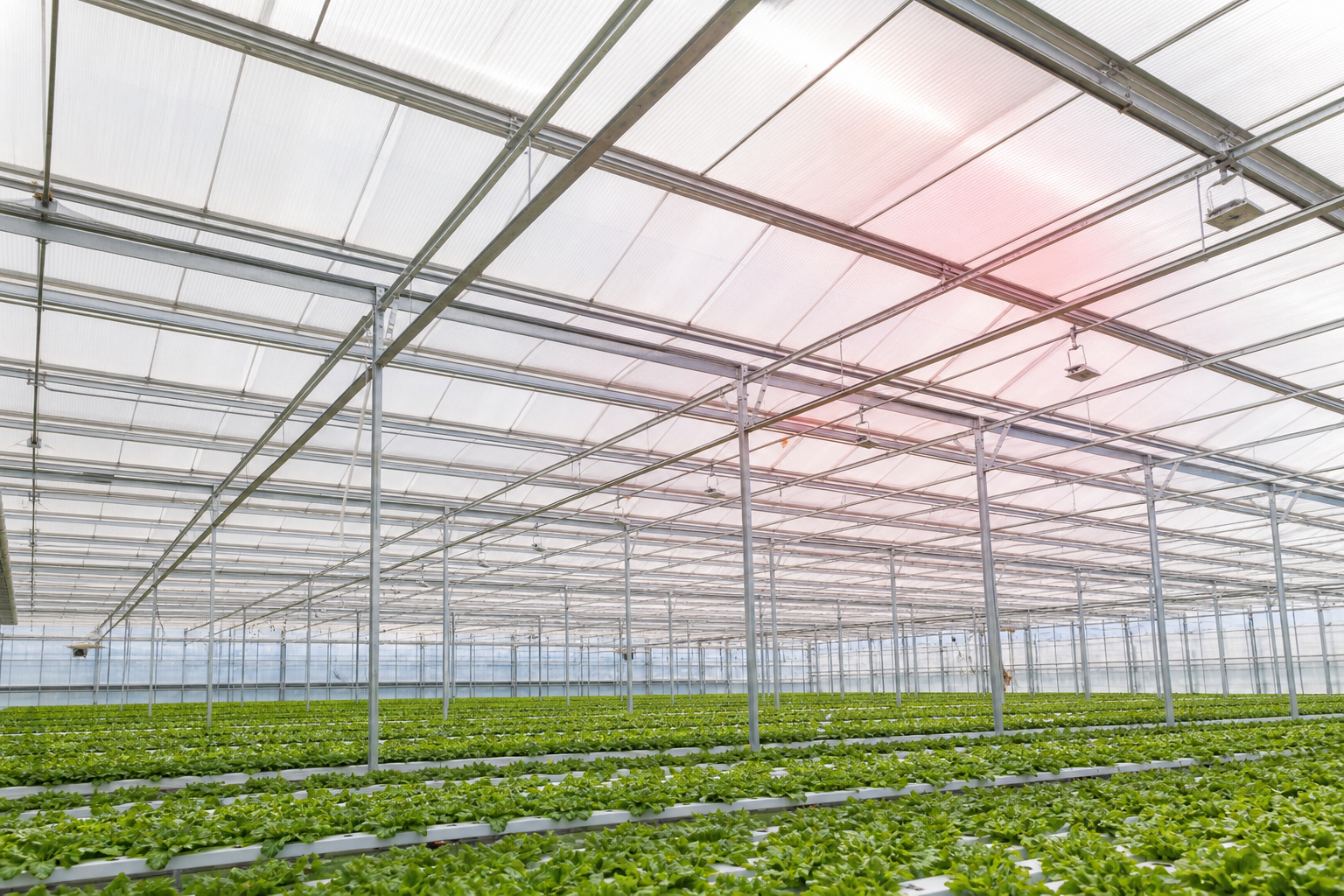
Light-conversion polycarbonate is a greenhouse glazing panel formulated to absorb selected shorter wavelengths and re-emit part of that energy at longer visible wavelengths. That definition is useful, but it is not enough for procurement. Commercial buyers still need to compare the finished panel’s spectral transmission, total transmission, haze, wall structure, UV protection and weathering data. A panel name or red tint does not prove how much light reaches the crop canopy.
This guide explains how the material works, which data are comparable, and how to prepare a technically complete request for quotation. It does not treat a spectral additive as a substitute for greenhouse design, climate control, crop management or a project-specific cultivation trial.
How spectral-shifting polycarbonate works
A light-conversion additive absorbs photons within a selected short-wavelength band and emits a portion of the absorbed energy at a longer wavelength. In practical greenhouse products, the formulation is compounded into or applied within a polycarbonate panel system. The result must be evaluated as a finished sheet because resin grade, additive loading, color, thickness, wall geometry and co-extruded layers can all affect the measured spectrum.
Conversion is not lossless. Some incoming energy is reflected, absorbed without useful re-emission or dissipated as heat. That is why a buyer should not compare only the emission peak. The more useful documents are the full spectral transmission curve, the measurement geometry, the sample thickness and the reference panel used for comparison.
For plant-lighting discussions, photosynthetic photon measurements commonly focus on the 400–700 nm range. A greenhouse buyer should still review wavelengths outside that band when the project involves UV exposure, photomorphogenic response, pest management or material ageing. The correct conclusion is project-specific: a spectrum can be different without automatically being better for every crop and season.
Light conversion and diffusion solve different problems
Light diffusion changes direction. A diffused panel spreads transmitted light over a wider range of angles, which can reduce sharp shadows and help light reach deeper into a dense canopy. Light conversion changes part of the wavelength distribution. These are independent properties, even though one greenhouse panel can be designed to provide both.
Use total transmission and haze to discuss diffusion. ASTM D1003-21 covers haze and luminous transmittance measurements for transparent plastics. Use a spectroradiometer or spectrophotometer report to discuss wavelength-dependent transmission or emission. Do not infer one property from the other: high haze does not prove spectral conversion, and a spectral-conversion curve does not prove useful canopy-level diffusion.
Six data sets to request before comparing panels
| Data set | Why it matters | What must be stated |
|---|---|---|
| Spectral transmission | Shows how transmission changes by wavelength | Wavelength range, resolution, instrument, sample thickness, wall structure and color |
| Emission or conversion response | Shows where absorbed energy is re-emitted | Excitation source, emission band, test geometry and reference sample |
| Total luminous transmission | Supports general daylight comparison | Test method, specimen conditioning and quoted product configuration |
| Haze or diffusion | Describes wide-angle scattering | Test method and whether the value is total haze or another diffusion metric |
| Weathering retention | Checks whether optical behavior is maintained | Exposure method, hours, irradiance, moisture cycle and before/after measurements |
| Panel construction | Connects laboratory data to the supplied sheet | Thickness, wall count, GSM or kg/m², UV side, width, length and tolerances |
Test data cannot be transferred blindly from one configuration to another. A 10 mm twin-wall sample and a 16 mm multiwall sample have different material paths and internal geometry. A report should identify the tested construction, not only the product family. For a baseline comparison, review a standard multiwall polycarbonate sheet with the same thickness and wall structure.
How to read a spectral chart
First check the axes and units. A chart may show percent transmission, relative intensity, irradiance or photon flux; those quantities are not interchangeable. Second, identify whether the curve represents incoming sunlight, transmitted light, fluorescence emission or a combined measurement. Third, confirm whether both test and reference samples were measured with the same instrument settings.
A buyer should ask for the numerical data behind the chart when optical performance is central to the project. An image of a curve is difficult to audit and cannot be integrated reliably into a greenhouse light model. Data points also make it possible to compare batches or evaluate performance after accelerated weathering.
Three procurement facts are worth stating clearly. A spectral peak alone does not quantify total converted energy. A colored panel can change transmission without producing fluorescence. Optical results for one thickness or wall structure do not automatically apply to another configuration.
Weathering, UV protection and optical retention
Greenhouse panels operate under sunlight, heat, moisture and cleaning cycles. The polycarbonate substrate, UV-protective layer and spectral additive must therefore be considered as a system. ISO 4892-2:2013 specifies xenon-arc exposure methods for plastics in the presence of moisture to reproduce aspects of daylight weathering under controlled conditions. Accelerated exposure is a comparison tool; it is not a direct calendar-year conversion unless a validated correlation is supplied.
Request the initial and post-exposure transmission, haze, color and spectral curves. Ask which side carries the UV-protective layer and how that side is identified on the protective film. If both sides can face outdoors, request documentation for the actual two-sided construction. Installation orientation is a procurement item, not just an installer detail.
How to evaluate crop claims
A crop trial is meaningful only when the reference and test zones are comparable. At minimum, review crop and cultivar, planting date, greenhouse location, panel age, roof geometry, ventilation, irrigation, temperature, humidity, nutrition, pest pressure, harvest definition and statistical treatment. A comparison against an ageing film is not equivalent to a comparison against a new panel with matched transmission.
Separate material evidence from agronomic evidence. A laboratory spectrum can show that the glazing changes transmitted wavelengths. It cannot by itself prove a commercial yield result. Conversely, a trial result without panel optical data is difficult to transfer to another site. Buyers should request both evidence types when the investment decision depends on crop performance.
Bakway also maintains a greenhouse field-results archive containing project observations for light-conversion film. Those tables are useful as application history, but they are not finished-panel validation and must not be transferred directly to a polycarbonate specification. A PC-panel purchase should use matched panel samples and a project trial.
Bakway’s smart-agriculture greenhouse panel page can be used to discuss the application route, but the final specification should be tied to the buyer’s crop, climate and greenhouse design.
Sample and pilot-test plan
- Approve the physical configuration. Confirm thickness, wall structure, GSM, width, color, UV side and protective film before optical comparison.
- Measure matched samples. Compare the light-conversion panel with a reference panel of equal thickness and structure using the same laboratory settings.
- Inspect installation effects. Review panel direction, support spacing, condensation management, sealing and dust accumulation.
- Run a controlled project trial when required. Use comparable greenhouse zones and pre-agreed crop and environmental measurements.
- Define acceptance criteria. Put optical tolerances, color limits, batch documentation and inspection frequency into the purchase specification.
RFQ checklist for commercial greenhouse projects
Send the greenhouse location, crop, roof drawings, panel thickness, wall structure, target transmission, haze or diffusion target, color, UV requirement, sheet dimensions, quantity, packing method and destination. State whether the project requires spectral data, matched reference samples, accelerated-weathering evidence or a trial batch. If a local code or fire classification applies, name the required document rather than asking for a generic certificate.
For a factory review, send a greenhouse panel RFQ with the specification and drawings. Bakway can then confirm which values are available for the quoted construction and which items require sample testing. For the next decision step, see the comparison of light-conversion and standard diffused polycarbonate panels.
Buyer conclusion
Light-conversion polycarbonate should be purchased as a measured glazing system, not as a color label or universal crop promise. The strongest procurement file connects the finished panel configuration to spectral data, transmission and haze measurements, weathering conditions, installation orientation and a project-specific crop evaluation plan. That evidence makes supplier quotations comparable and reduces the risk of paying for an optical claim that is not defined in the purchase specification.