

Industrial Roofing with Polycarbonate: A Complete Buyer’s Guide for Factory and Warehouse Applications

Introduction: The Real Cost of Industrial Roofing Material Failure
A single roofing panel failure in an industrial facility costs far more than the replacement sheet. When a roof leaks, production lines stop, inventory gets damaged, and workers face safety hazards. According to EN 16240:2014, material selection errors account for over 40% of premature roofing failures in commercial buildings. The choice between traditional metal sheeting, glass, fiberglass, and modern polycarbonate roofing panels determines whether a roof delivers 5 years or 25 years of trouble-free service.
Polycarbonate has emerged as the preferred industrial roofing solution for factories, warehouses, and agricultural facilities worldwide. This guide provides the technical data procurement managers and facility engineers need to specify polycarbonate roofing correctly.
Why Polycarbonate Outperforms Traditional Roofing Materials
Industrial roofing faces three relentless enemies: impact, UV radiation, and thermal cycling. Polycarbonate addresses all three at a fundamental material level.
Impact Resistance: 250× Glass
Polycarbonate’s notched Izod impact strength of 600–850 J/m (ISO 180/A) makes it 250 times more impact-resistant than float glass. A 6 mm solid polycarbonate sheet withstands hailstones up to 25 mm diameter and windborne debris — impacts that shatter glass and crack fiberglass. For factories in hail-prone regions, this eliminates the annual replacement budget for broken skylights.
Weight Advantage: Half the Weight, Lower Structural Cost
A 10 mm solid polycarbonate sheet weighs approximately 12 kg/m² versus over 25 kg/m² for equivalent-toughness laminated glass. Multiwall panels are even lighter — a 16 mm triple-wall panel weighs just 2.7–3.0 kg/m². This translates directly to 20–30% savings on structural steel framing and faster installation with smaller crews. For retrofit projects with limited load capacity, polycarbonate is often the only viable transparent roofing option.
Three Polycarbonate Roofing Types: Choosing the Right Product
Solid Polycarbonate Sheets (2 mm – 15 mm)
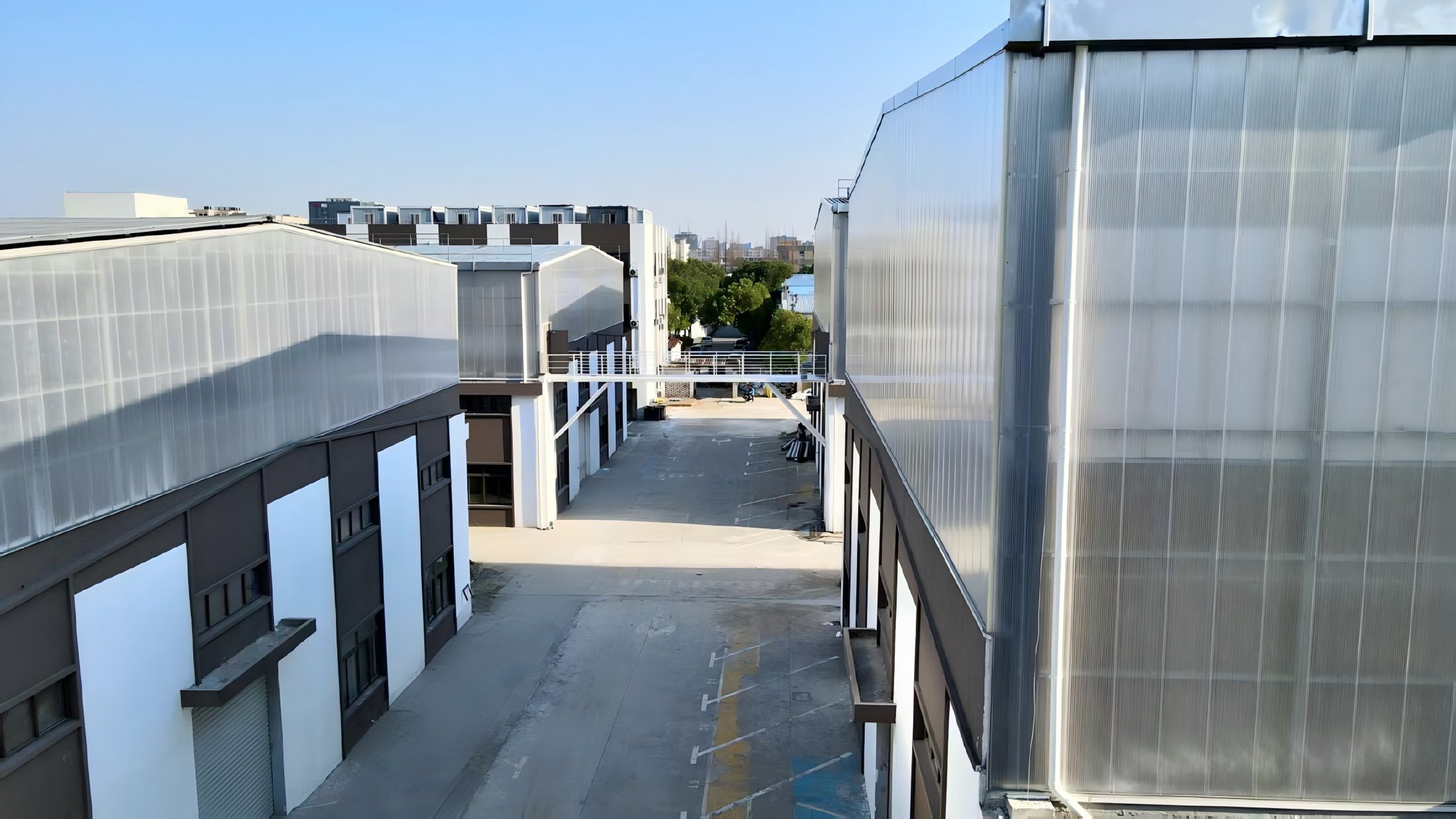
Monolithic panels offering maximum clarity (up to 90% light transmission) and the highest load-bearing capacity. Ideal for security-critical skylights and areas requiring maximum impact protection. Our solid polycarbonate sheets are available with anti-scratch hard coating and UV co-extrusion.
Multiwall Polycarbonate Sheets (4 mm – 25 mm+)
Internal rib structures create insulating air cavities achieving U-values as low as 1.2–1.8 W/m²·K — competitive with double-glazed glass at one-sixth the weight. These dominate industrial daylighting, warehouse roofing, and factory skylights. See our multiwall polycarbonate sheets for full thermal performance data.
Corrugated Polycarbonate Sheets (0.8 mm – 2 mm)
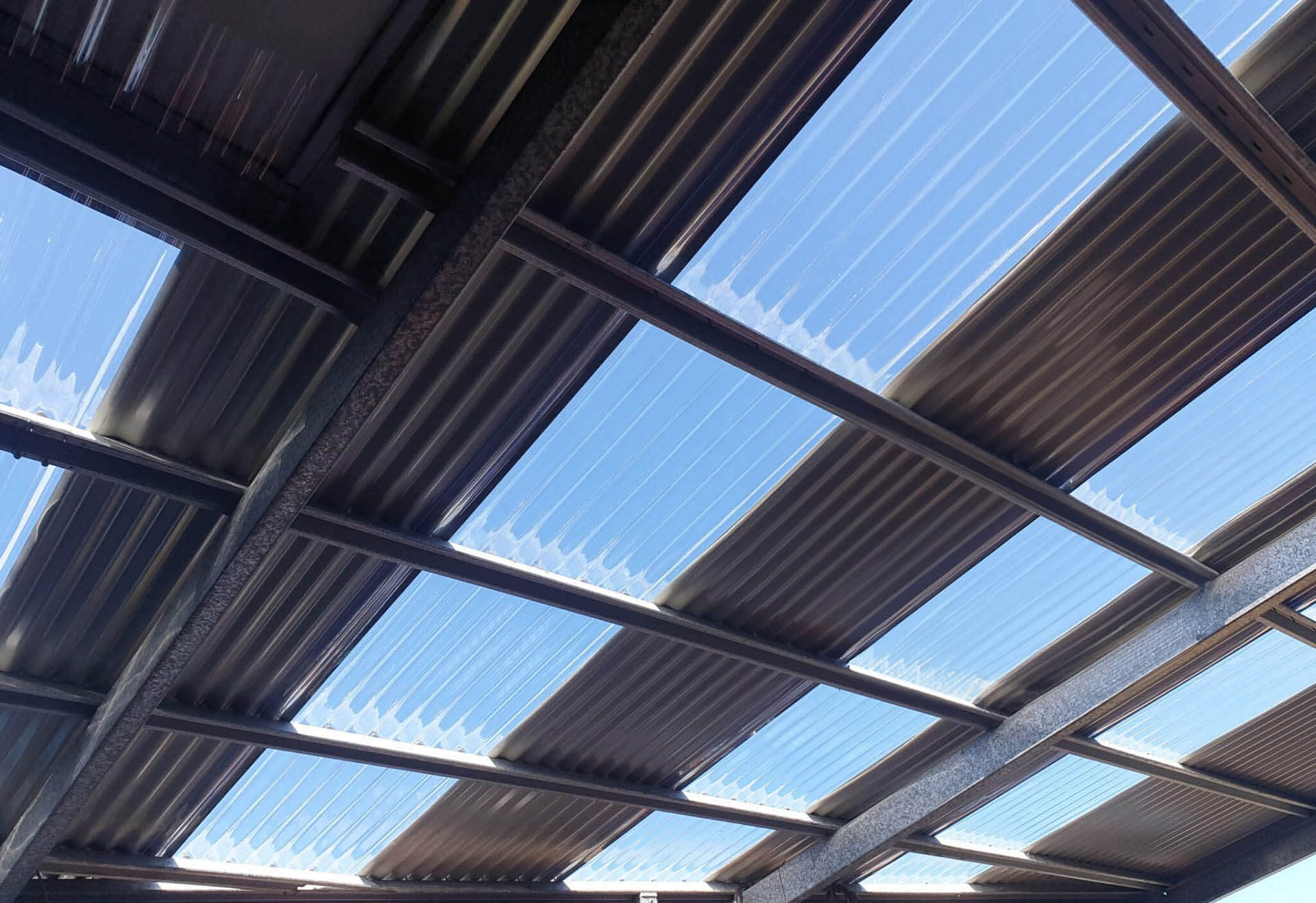
Profile-driven stiffness enables spans up to 1,200 mm at just 1.2 mm material thickness — the most cost-effective option for agricultural sheds and light industrial canopies. Our corrugated polycarbonate sheets match standard metal roofing profiles for seamless integration.
Thickness and Span Selection: The Engineering Framework
Roofing thickness is governed by three variables: wind load, snow load, and support spacing. Per EN 1991-1-4, a factory in Zone 2 (25 m/s design wind) experiences approximately 0.8–1.2 kN/m² uplift on the roof perimeter:
| Application | Recommended Thickness | Max Purlin Spacing | Sheet Type |
|---|---|---|---|
| Light industrial canopy | 6–8 mm | 700–1,000 mm | Twin-wall / Corrugated |
| Factory daylighting / skylight | 10–16 mm | 1,000–1,500 mm | Triple-wall / Solid |
| Full-span warehouse roof | 16–25 mm | 1,500–2,000 mm | Five-wall / Multi-cell |
| Cold storage / freezer facility | 20–25 mm | 1,000–1,500 mm | Multi-wall with thermal break |
| Coastal / hurricane zone | 12–15 mm solid or 25 mm MW | 1,000 mm max | Solid / Enhanced multiwall |
Always verify specifications against local building codes. Provide your site’s design wind speed, ground snow load, and purlin spacing when requesting a quotation for an engineered recommendation.
UV Protection and Long-Term Durability
Industrial roofing faces continuous UV exposure that degrades unprotected polymers within 3–5 years. Co-extruded UV protection — where a 50–80 μm UV-absorbing layer is molecularly bonded during extrusion — is the industry standard with a 10+ year service life. Per ISO 4892-2 accelerated weathering, quality co-extruded polycarbonate shows yellowness index change (ΔYI) below 5 after 3,000 hours of xenon-arc exposure.
Three critical UV specifications to verify: (1) co-extruded UV layer minimum 50 μm on the weather-facing side; (2) ISO 4892-2 test report showing ΔYI < 5 at 2,000+ hours; and (3) a minimum 10-year warranty against yellowing and loss of mechanical properties. Bakway's IATF 16949-certified production includes all three as standard.
Thermal Insulation: Reducing HVAC Costs Year After Year
Heating and cooling represent 30–50% of a typical industrial facility’s energy budget. Single-pane glass roofing has a U-value of approximately 5.7 W/m²·K — essentially no insulation. Multiwall polycarbonate achieves dramatically better thermal performance:
- 8–10 mm twin-wall: U-value 3.0–3.5 W/m²·K — 40% better than single-pane glass
- 16 mm triple-wall: U-value 1.9–2.2 W/m²·K — approaches double-glazed glass
- 20–25 mm five-wall: U-value 1.2–1.6 W/m²·K — competitive with insulated glass units
For a 10,000 m² warehouse, upgrading from 10 mm twin-wall to 16 mm triple-wall roofing can reduce annual HVAC energy consumption by 85–120 MWh — approximately $8,500–$14,000 in annual savings. Over the 15-year service life, energy savings alone can exceed the total installed roofing cost. Verify U-values per ISO 8301 or EN 12667.
Installation Best Practices for Polycarbonate Industrial Roofing
Three installation errors account for over 70% of polycarbonate roofing warranty claims:
1. Insufficient Thermal Expansion Clearance
Polycarbonate expands at 0.065 mm/m·°C (ISO 11359-2). A 6-meter panel experiencing a 50°C seasonal swing expands 19.5 mm. Without adequate expansion gaps (minimum 3–4 mm per meter), the panel buckles and fastener holes crack. Always drill mounting holes 2–3 mm oversize with EPDM washers.
2. Incorrect Panel Orientation
Multiwall panels must be installed with internal ribs running vertically for condensation drainage. The UV-protected side (marked on protective film) must face outward — installing backwards voids the warranty and reduces service life by 60–70%.
3. Improper Edge Sealing
Apply breathable anti-dust tape at the bottom edge (allows drainage) and solid aluminum tape at the top edge (prevents moisture ingress). This extends panel service life by 5+ years in humid or dusty environments.
Lifecycle Cost Analysis: First Cost vs. Total Ownership
Procurement managers evaluating roofing solely on per-square-meter material cost make the industry’s most expensive mistake:
| Cost Factor | Metal Sheeting | Glass Skylights | Polycarbonate (Multiwall) |
|---|---|---|---|
| Material cost (per m²) | $8–15 | $25–50 | $12–22 |
| Structural framing | Medium | Heavy (adds $15–25/m²) | Light |
| Daylighting | None (opaque) | 88–91% transmission | 65–82% transmission |
| Breakage / replacement | Dent, rust (15–20 yr) | 5–10% annual breakage | Near-zero breakage |
| 15-year lifecycle cost | Medium | HIGH | LOW |
The total installed cost of polycarbonate roofing is typically 20–35% lower than glass skylight systems when structural, installation labor, and breakage factors are included. Combined with ongoing energy savings from superior thermal insulation, the 15-year total cost of ownership consistently favors polycarbonate for industrial applications.
Engineering Resources for Your Roofing Project
Before finalizing a specification, run the numbers: our load capacity and wind load rating guide shows how to read span tables for snow and wind loads, and the contractor installation guide covers the fastening and thermal-expansion details that determine whether the roof reaches its rated life. For enclosed process areas, check fire ratings before specifying.
Frequently Asked Questions
Q: How long does polycarbonate industrial roofing last?
A: Co-extruded UV-protected polycarbonate roofing panels from certified manufacturers deliver a 10–15 year design service life. Key longevity factors: co-extruded UV protection (50+ μm layer) maintaining over 85% light transmission after 10 years per ISO 4892-2; proper thermal expansion gaps (3–4 mm/m); and virgin resin material. Bakway provides a 10-year limited warranty against yellowing and loss of mechanical properties, backed by IATF 16949 batch traceability.
Q: Does polycarbonate roofing meet industrial fire safety codes?
A: Yes. Standard polycarbonate achieves Class B-s1,d0 per EN 13501-1 (limited combustibility, low smoke, no flaming droplets). For facilities requiring enhanced fire performance — chemical plants, food processing — flame-retardant grades achieving UL 94 V-0 are available. Always verify local building code requirements. Bakway provides fire test certificates with every project order.
Q: Can polycarbonate roofing reduce lighting costs in factories?
A: Yes. Polycarbonate roofing with 65–82% visible light transmission provides natural daylighting that reduces daytime artificial lighting by 40–60%, per Lawrence Berkeley National Laboratory (2019). Multiwall panels with opal or diffused finishes distribute light evenly across factory floors — eliminating harsh glare and shadow spots that compromise worker safety and quality inspection accuracy.
Conclusion: Specify Industrial Roofing for 15 Years, Not 5
Industrial roofing is a long-term capital investment. Polycarbonate’s unique combination of impact resistance (250× glass), thermal insulation (U-value 1.2–2.2 W/m²·K), lightweight construction (50% lighter than glass), and co-extruded UV durability (10+ year warranty) makes it the rational economic choice for factory roofing, warehouse daylighting, and industrial canopies.
When sourcing polycarbonate roofing, the manufacturer’s certification matters as much as the material specification. IATF 16949 certification ensures statistical process control, full batch traceability, and documented test reports. Contact Bakway for a project-specific quotation including structural load calculations and free A4 samples for evaluation.
About Suzhou Bakway New Materials Co., Ltd. — Suzhou Bakway New Materials Co., Ltd. supplies polycarbonate sheets from China, with a 40,000 m² Huai’an production site with a 25,000 m² factory building, plus a nearly 3,000 m² Suzhou processing base. Located just 80km from Shanghai Port, we offer efficient sea freight worldwide. Our Singapore and Indonesia branches enable direct transshipment globally, saving significant import duties for customers. With IATF 16949, ISO 9001 and ISO 14001 certifications, we provide 23+ precision processing services to clients across 60+ countries and regions. Contact us for free samples and competitive quotes.
Specifying panels for a full roof package? Compare solid, multiwall and corrugated options on our polycarbonate roofing sheets overview, or send span and load data for an engineering review before quoting.
References
- EN 16240:2014 — Light transmitting flat solid polycarbonate sheets for roofs, walls and ceilings. CEN.
- EN 1991-1-4:2005 — Eurocode 1: Actions on structures — Wind actions. CEN.
- ISO 180:2023 — Plastics — Determination of Izod impact strength. ISO.
- ISO 4892-2:2013 — Plastics — Exposure to laboratory light sources — Xenon-arc lamps. ISO.
- ISO 8301 / EN 12667 — Thermal insulation — Determination of steady-state thermal resistance.
- ISO 11359-2:2021 — Plastics — Thermomechanical analysis — Coefficient of linear thermal expansion.
- Lawrence Berkeley National Laboratory (2019) — Daylighting in Commercial and Industrial Facilities.